bloodteethandflame

A life in threes

Month: July, 2018

Month for Loki, Day 8: And speaking of drinks….

One of the specific drinks that I have offered Loki is a Whiskey Ginger

which is

  • equal parts Jameson’s Irish Whiskey and ginger ale
  • a splash of lime juice
  • a lime wedge garnish (optional)

Also called the Irish Buck (Or Mule)

 The variation that I often partake of myself is 1 part Whiskey, 1 part Ginger Ale and 1 part fresh squeezed lemonade.


Hail Loki!


Month for Loki, Day 7: One Meaningful Offering


Recently, I was having a conversation with another Lokean, and we were talking about the importance of making offerings.

Though it was not my intent to put undue pressure on anyone to make elaborate offerings -as time, finances, and other factors can make that difficult – I wanted to stress the importance of making an offering.

It can be of utmost importance to make an offering…as the following passage from author Jenny Blain’s book, Nine Worlds of Seid-Magic  illustrates this point quite well:

“The process of initiation, by spirits or deities, not people, can be quite terrifying.  The experience of the seeress Rauðhildr is a case in point. This is how it appears in my field notes, written after she had told me the story in a coffee shop in Berkeley, California.

She made the journey to visit the Maurnir, who (according to her and Diana [Paxson]) are female giants. The Maurnir dwell in a cave, and she went there, naively she says because she thought it would be interesting.  She was attempting to journey to all the denizens of the Nine Worlds.

They were there, and they saw her and asked why she was there.  The Maurnir have much wisdom, and she asked (again naively, she says) if they would teach her if she could learn from them, share in their wisdom.  They said no, they couldn’t teach her, but if she wished she could become part of their wisdom. She agreed that this would be a good thing.

So they ate her.

They threw aside the bones, as they ate. Her bones were lying on the cavern floor when Loki appeared and started dancing and singing, calling to the goddesses and gods to put her back together, which they eventually did.  So Loki was dancing a shaman dance.  When she came together again, she thanked him and asked him why he’d done this. He said ‘once, you gave me a drink.’ (as an offering in ritual).”


You might notice the key in that passage is “He said ‘once, you gave me a drink.”

Once.

As you may have realized, one meaningful offering to Loki can make all the difference.

Indeed.

~~~

  • Jenny Blain, Nine Worlds of Seid-Magic: Ecstasy and Neo-Shamanism in Northern European Paganism, Routledge, New York, NY, 2002, p.22-3.

Month for Loki, Day 6: Because this time he did not need to chase you

This.

(https://kernaia.wordpress.com/2017/04/23/the-beginners-guide-to-devotion/)

Back in April 2017, I read the above beautifully written post – titled ‘A Beginner’s Guide to Devotion’ shared on my WordPress feed – written by Alex of Wildwood and Wild Hunt.

It is quite possibly the most profoundly succinct description of the devotional relationship with Deity that I have ever read, so I often find myself going back to it, and re-reading it…especially nowadays.

I am simply re-blogging – so please give Alex all of the praise.

Thank you!

~~~

“i. step, stumble. fall. your falling is sacred, but your rising again is glorious.

ii. step, stumble. fall. rinse, repeat. rinse, repeat. this is the secret they are all telling you, the mystery they are all hiding. one and the same thing, and all it amounts to is your beloved whispering in your ear don’t give up.

iii. tomorrow you will forget to love him. it does not matter. how old is he, how huge? days pass like drawing breath – he will still love you afterwards.

iv. scream, rage, collapse. the shrine dismantled and reassembled and dismantled again, but you are still his, and this is still sacred.

v. he is huge, dazzling, awe-inspiring. you think you saw his face, truly his face, peering from between branches yesterday. what have you got yourself into, what have you done? you think maybe you are crazy, you think maybe you should run.

vi. you are crazy. you do run. he finds you anyway. he burns through your veins like fire, and his finding is the sweetest moment since the last. it will not happen again.

vii. it does happen again. still he finds you, still the moment of finding is glorious. later you break down, you cannot keep doing this, he deserves more than this, the same faith he has shown you.

viii. he does not love you because he wants you to be a version of himself. he loves you for the self you are, and the self you will be.

ix. the next time you run, you find your own way back. he is waiting for you, joy spilling from him because this time he did not need to chase you.

x. love. love until your heart is raw, your voice is hoarse, and your lungs are fighting for breath. you can never love him enough, but you will go to your end trying.”

~~~

Hail Loki ❤

Month for Loki, Day 5: The Runes of Your Name (I)

ISA


Isa is a rune associated with ice and winter itself, representing the icicle that will turn to water. Isa represents a forced stillness, a period of rest before activity, as in winter, there is nothing to do but wait for the ice to transform into water again.  Therefore, Isa is the essence of Stillness, signifying a delay that may lead to a new start, or a call for inward focus (introspection) in contemplation and preparation.  Another aspect of Isa which is also evoked by its nature as ice is that Isa can represent containment, as ice still holds the kinetic energy/movement of water within itself – as Isa only appears to be still. Related to this, Isa can be the layer of shimmering ice on the surface of a frozen lake that gives the illusion of stability and safety that only becomes treacherous if one should tread upon it without forethought and wisdom.


As the final rune in Loki’s name, I believe that Isa represents the ice at the advent of creation, as Isa evokes His primordial nature as a Jotun, as Beings of transformative energy and the unity of opposites in nature.

As well, Loki is a master of illusion, much like that frozen layer of ice on the surface of the lake; approaching Loki without wisdom and forethought can be treacherous.


In conclusion, one may see in the runes of Loki’s name, there are the forces that oppose (fire and ice) that are the essence of creation.

As an agent of change and transformation, perhaps these are the forces that Loki represents at Ragnarok: the chaos that brings balance, and the overwhelming change that damages then heals.

As well, during the Lokasenna, perhaps Loki serves as the illumination of sudden insight (Kenaz) and the warning (Kaunen) – the mark of the wound that exists to highlight the sickness and disorder – that needs to be dealt with in order to heal and progress

Three runes -Laguz, Kenaz, and Isa – represent the duality of the shapeshifting transformative forces of His energy and His nature –  and perhaps these energies combine to strengthen, expose, and temper the concurrent forces of overwhelm, incineration, and damage that echo through Othala as the rune of ancestral knowledge and memory.


Hail Loki indeed ❤

Month for Loki, Day 4: The Runes of Your Name (K)

KENAZ

The Elder Futhark rune, Kenaz is the torch, a rune of knowledge, teaching and learning. Inspiration and knowledge are often associated with light, as in “enlightenment” or “shedding light on the problem.” Kenaz is the act of bringing light, a force that makes the invisible visible, uncovering truth and bringing light to the unseen. In this sense, Kenaz is a rune that represents the flame of revelation.

As well, Kenaz can also be interpreted as the flame that welcomes, the flame at the hearth, which is the fire which hallows (makes sacred) a space.

In a similar way that Laguz is the flowing energy of water that must be controlled, so does Kenaz hold the powerful energy of fire – a force which is capable of being a beacon and a destroyer – as a welcoming fire could just as easily burn out of control if one becomes complacent about its power. Kenaz is a rune of sudden, rapid insight and discovery.

Related to this meaning, the Anglo-Saxons interpreted this rune as Kaunen/Cen a rune that is not only the essence of the torch’s flame that illuminates the shadows, but a rune that symbolizes an ulcer, boil or wound. In that sense, this rune the heat of a fever, the mark of an illness that can easily lead to death, or metaphorically, the frenzy that can be brought on by sudden revelations that leads to delusion and/or madness.


Though many scholars may disagree with me, as a rune in Loki’s name, I interpret Kenaz as evoking Loki’s energetic association with fire.  Kenaz is the light of knowledge, the force that illuminates the shadows, and the symbol of the welcoming hearth-fire at the center of the home.

As well, I see the relation to Loki’s energy in both the Elder Futhark and Anglo-Saxon runic forms: as the Kenaz rune echoes the energetic duality as fire as a provider and destroyer similar to the rune Laguz’s duality of water – and as Kaunen, the rune that symbolizes the boil/ulcer, the fevered mark of an illness – the fever that needs to break before one can be healed, or the damage that must be attended to, as Kaunen is both the warning and the reminder that must be heeded to avoid death/disaster.

Month for Loki, Day 3: The Runes of Your Name (O)

OTHALA

Othala is a rune that represents a wealth that cannot be sold, just as its shape evokes the boundary that surrounds an enclosure whose contents cannot be taken away. As a symbol, Othala is a protective rune that maintains and preserves that which it protects within its framework. In that sense, Othala represents that which belongs to the individual by natural law. But Othala represents more than physical property and boundaries – Othala represents home, family and community, as well.  Othala symbolizes the cultural and spiritual heritage that has been passed down to us by our ancestors. Othala is the rune of that ancestral connection, representing the thread of ancient knowledge and wyrd.

~~~

Some rune-workers consider Othala as the final rune in Elder Futhark, and believe that in that sense, Othala contains the potential power of all the other runes. As well, Othala represents powerful ancestral memory and wisdom…the shared genetic memory-wisdom that links and therefore unifies all human beings throughout time.(1)

Author Dagulf Loptson sees the second rune in Loki’s name, Othala  as representing both what Loki values (family and home), but also what He both struggles with (His Jotun ancestry) and what He seeks (a sense of belonging with the Aesir).  Loptson sees the energy of Othala in Loki’s name as being how chaotic energy has been harnessed and used for the security of a community, as Loki inadvertently provides the Aesir with a form of physical wealth/property through gifts (Thor’s hammer, Odin’s spear, Freyr’s ship) that were won through the use of His mental gifts (negotiation/wit with the dwarves). In another situation, Loki provides another form of protection to the Aesir in the form of a physical boundary (the wall around Asgard) through use of one of His ancestral gifts (shapeshifting). (2)

Personally, I have come to see Othala similarly, as a rune of ancestral memory.  In my opinion, how the second rune of His name applies to Loki is that, as a Jotun, Loki is in essence, a powerful and creative force of nature. Some scholars have theorized that Loki could be identified as one of the trio of ancestral creators – as Lóðurr – who animated the first humans – Ask and Embla – with Hœnir and Odin, as described in in the Völuspá.  

~~~

(1.) http://runesecrets.com/rune-meanings/othala-rune-meaning-analysis

(2.) Loptson, Dagulf, Playing With Fire: An Exploration of Loki Laufeyjarson, Asphodel Press, Hubbardston, MA, 2014, p.216

Month for Loki, Day 2: The Runes of Your Name (L)

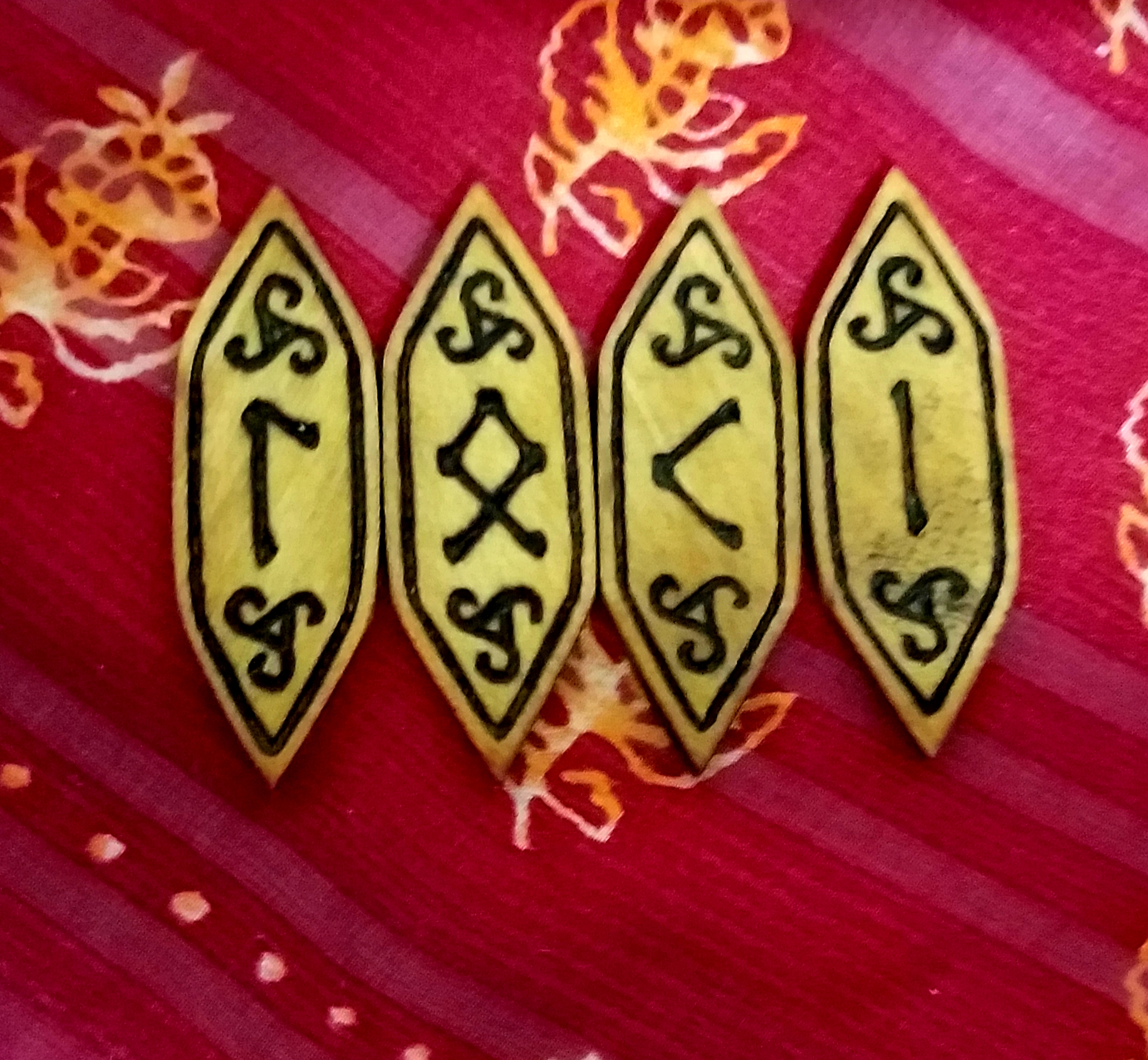
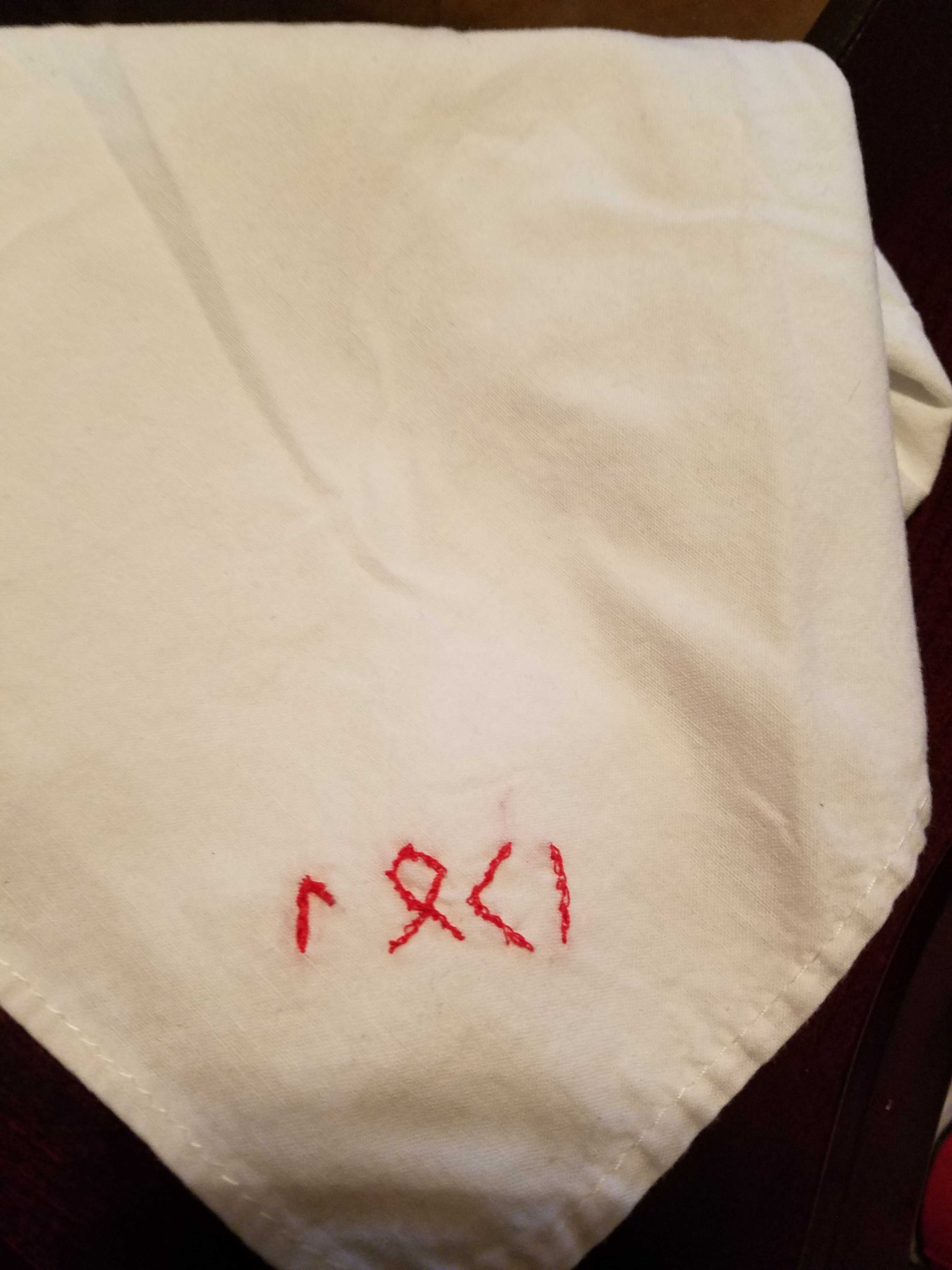
One of the first things I ever did to honor Loki was to embroider an altar cloth featuring the four runes of His name, in Elder Futhark:

(Laguz Othala Kenaz Isa)

Aside from the strange (but perhaps not so surprising) difficulty that I experienced in the process of embroidering this cloth, I do remember that as a time when the meaning of the runes themselves confused me…as I had only begun to learn their mysteries.

However, in the intervening years since then,  I have come to study runes, and the most important thing I have learned is that runes aren’t just an alphabet system; each rune has an energy and spirit of its own.  And as any rune-worker can tell you: working with the runes is to work with the layers of spiritual presence and power held by each rune. One of the meanings of the word ‘rune’ is ‘secret’ – so one might begin to see why it is sometimes said that the runes themselves reveal their secrets as one works with them.

I’m sure you’ve heard it said that words are important because words are powerful. Their power comes from the ability of words to make our thoughts manifest.

Now imagine if you would how this concept operates regarding runes: if each rune has its own layers of spiritual connection and meaning, therefore the power of several runes can be created in the formation of words.

Now, consider the power of names.

Names are powerful in the sense that a name is a personal word-thing.

With this in mind, let’s consider the runes of Loki’s name.

First…

LAGUZ

Laguz is the flow of Water. Laguz is the flow of Wyrd – the pools and the depths. Laguz is forward progress that seeks the cracks in the obstacles and blockages.  Laguz is a paradox just as water is: like water, Laguz represents a balm that can soothe and strengthen and Laguz is the force that can threaten and overwhelm all that is within its path.

As a part of Loki’s name, Laguz is the representation of energetic flow, as the energetic forces within, the essence of the subconscious mind; intuitive thought and emotion.

 Like Loki Himself, Laguz represents a shapeshifting nature, as water is shapeless, formless, taking the shape of its container, and yet it seeks its own path; it can be blocked by an obstacle or it can simply flow around it, much like Loki’s ever-changing energy.

Laguz is a rune that embodies a dual-nature, much like Loki’s: Laguz is an energetic force much like the ocean; a force that can be calm and full of provision and promise, or a force can overwhelm and destroy.

And finally, Laguz is a rune of awareness of what lies beneath the surface, a rune of knowledge and psychic ability.

Writing, rituals, prayer beads, and ‘fidget cubes.’

Otherwise known as ritual distractions.

I know it’s been a while, but isn’t it always?

I cannot say that I haven’t been writing – because I have – but as usual, I haven’t been posting as often as I’d intend.

There’s something about the ritual of sitting in this chair and writing that works for me, and yet, posting rarely seems part of that process.  I have been thinking a lot about processes and rituals as I am currently overthinking..er, writing…a small collection of rituals.

Perhaps it is more of a devotional, as much of what I’ve written leans more towards personal devotional rituals for the solitary practitioner.

At any rate, it is as it has always been…though I have been writing, I have not been posting in this blog.

It occurred to me that I have been dragging my feet lately, as I resolved in the new year to focus more upon not just writing but organizing my devotional practice into something much more coherent than it has been.  Long have I been getting the nudge to consolidate the jumble of notebooks and computer files into a consistent organized whole.

I know that my life could benefit from a more structured approach…and yet, the more I focus upon the task of collection and consolidation, the more scatterbrained I feel.  I feel like a student all over again, hunched over my desk, busily compiling five years’ worth of devotional writing from the stack of notebooks, the relevant pages clinched by paper clips with worn covers peppered with Post-It notes.

In an attempt to help, my son suggested that I try using a ‘fidget cube’ – a desk ‘toy’ designed to help one focus – as he claims that being allowed to use one in class has improved his ability to focus while writing.

So, I held the fidget cube in my left hand while I transcribed my notes on Anglo-Saxon runes and a Beltane bonfire ritual into my laptop.

~~~

Later that evening, when I was sitting in front of my altar, attempting to meditate, my mind kept wandering toward other things.

Distracted by thoughts of runes, bonfires and masks, I struggled to push those thoughts and attendant vivid imagery aside.

I opened my eyes, and my gaze settled upon the mala beads that lay atop the cigar box in the center of my altar.

Recalling how this mala had helped me focus in the past, I reached for them, closed my eyes, and settled into the words of the prayer that I had created for them.  While the prayer I created for them is simple and almost repetitive in its rhythm – as that is exactly what I need when I have difficulty focusing – I have said this prayer so regularly… that it suddenly became clear that something wasn’t working.

My breathing felt off, and my thoughts kept trailing off in strange ways so much so that I kept losing track of the words.

Disturbed, I opened my eyes, and looked down at the beads in my right hand…as if the beads were the problem.

Funny that…because I know better.

But it definitely occurred to me that I needed to do something else to focus.

I thought about that fidget cube on my desk in the other room.

And it got me to thinking of the similarities between this mala and the idea of fidget cubes as the concept is perhaps the same:

It seems to have always been true of me that in order to force my mind to be still, I have to be doing something.

I have to be moving in some way, however small or slight.

And so I reached for the fidget cube.

It has six sides – each side requiring a different movements of the fingers: pressing a button, flicking a switch, rolling the thumb over a ball bearing, or spinning a small dial that makes a satisfying clicking sound…

(Yes, that one….)

Clickity. Clickity. Click.

And so I settled into that.

Odd…but it *worked*

Hm.

So here’s to a different technology, I guess.


Though now that I think about it…it did sound a lot like typing.

Huh.