bloodteethandflame

A life in threes

Category: historical basis

Month for Loki: Three

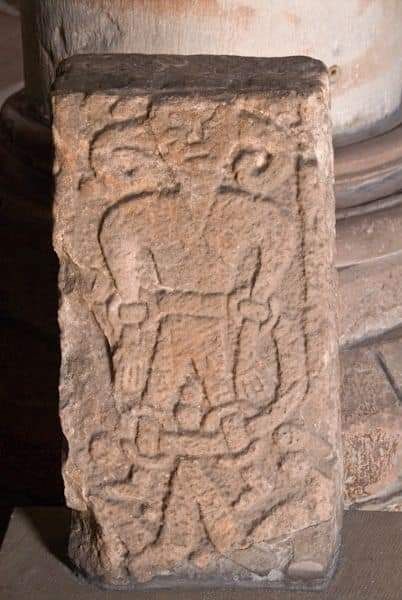
The Kirkby stone, from website: http//www.britainnexpress.com

Picture caption from website:

“The Loki Stone is an 8th century carved representation of the Norse God Loki, bound and chained. It is one of only two known carvings of this type in Europe, and the only one in Britain. We do not know how the stone came to be in Kirkby Stephen, but it serves to remind us of the Norse influence in this region during prior to the Norman invasion of 1066.

We do not know where the stone was originally located. It has been moved several times over the centuries, and for many years it sat amongst a collection of old gravestones outside the east end of St Stephen’s church, open to the elements. Thankfully, it has now found a home inside the church, immediately opposite the south door, where it can be instantly seen by visitors on entering.”

Hail Loki! ❤️

Month for Loki: Six

Do you believe that Loki and Lóðurr from the creation myth are the same god? Why or why not?

Yes, I do believe that Loki, Loptr, and Lóðurr could be references to the same — if not different faces/aspects of the same deity.

(a) There’s the theory proposed by the scholar Ursula Dronke that Lóðurr is “a third name of Loki/Loptr”. Her argument rests upon the mention of Odin, Hœnir, and Loki as a trio of Norse deities/beings in a few late folkloric writings, including the Haustlöng, in the prologue to Reginsmál, and also in the Faroese ballad, Loka Táttur.

(b) As well, the kenning for Odin, Lóðurr’s friend appears to parallel another well-known kenning for Odin, Loptr’s friend – just as Loki is similarly referred to as Hœnir’s friend in the Haustlöng — which I believe further suggests their connection as a trio of deities/beings.

While many scholars may agree with this identification, I realize that it is not universally accepted. One argument that can be made against this argument is that Loki appears as a malevolent being later in Völuspá, which does seem to conflict with the image of Lóðurr as a “mighty and loving” figure.

Many scholars, including Jan de Vries and Georges Dumézil, have also identified Lóðurr as being the same deity as Loki.

(c) Scholar Haukur Þorgeirsson suggests that Loki and Lóðurr were different names for the same deity based on that Loki is referred to as Lóðurr in the rímur Lokrur.(1) Þorgeirsson argues that the writer of the rímur Lokrur may have had access to information about this identification from an earlier traditional extant tale or that perhaps the author had drawn that conclusion based on a possible comparative reference to the Prose Edda, as Snorri does not mention Lóðurr.

Since knowledge of the contents of the Poetic Edda could just as easily not have been accessible – or familiar – to every poet around 1400 AD when the rímur was written, still Þorgeirsson argues for the traditional identification, by pointing to Þrymlur where the same identification is made with Loki and Lóðurr. Again, Þorgeirsson mentions the possibility that the 14th- and 15th-century poets possessed written sources unknown to us, or the idea must have come from an unlikely source where the poets could have drawn a similar conclusion that Loki and Lóðurr are identical, but the sources of that (possibly oral) tradition remain presently unknown. He concludes that if Lóðurr was historically considered an independent deity from Loki, then a discussion of when and why Lóðurr became identified with Loki is an intriguing concept that deserves more exploration, and in his article (linked below), he discusses what he believes are several possibilities, based upon what is known about poetic and linguistic structures in the 14th and 15th century.

(d) Since the Prose Edda mentions the sons of Borr in the same context as Völuspá mentions Hœnir and Lóðurr, some scholars have reasoned that Lóðurr might be another name for either Vili or Vé. (Viktor Rydberg was an early proponent of this theory, even though it seems that he may have abandoned support of it later, as mentioned by Þorgeirsson in his article linked below .)

~~

(1) “Outside of the rímur, the name Lóðurr occurs in three Old Icelandic poems; Háleygjatal, Íslendingadrápa, and Völuspá. In each case, it indicates a figure associated with Óðinn, but scholars have been divided on exactly whom the name refers to. The theory which is most frequently defended – and most frequently attacked – is that the name refers to Loki.” from Haukur Þorgeirsson’s article, “Lokrur, Lóðurr, and Late Evidencehere (on Academia.com)


Month for Loki, Fourteenth: Knot.

In the summer of 2012, I had one of the first of a series of strange vivid dreams  that involved Loki:

In this particular dream, I found myself searching through  a building of many rooms, and while I didn’t know what or who I was looking for, I knew I was looking for something…or someone.

Most of the rooms were spacious but empty – white walls, sparsely furnished, lit by buzzing fluorescent ceiling panels.  Like an abandoned office building, which I sensed may or may not be underground.

And then I was surprised to come upon what appeared to be a middle-aged man with dark auburn hair in one of the rooms.  As I’d mentioned, though most of the rooms were nothing more that white empty walls, the room this man was in was full of  brightly colored yarn.   Skeins of various colors and in various states of unravel lay scattered all over the floor.  While a few seemed no more than tangled handfuls of yarn, others were neatly wound and stacked in piles of three or four bundles, sorted by color.

Meanwhile the biggest jumble of knots lay closest to the man’s right foot.  I could also see that he was barefoot…. and he wasn’t exactly sitting in the chair.

This man was sprawled in an elaborately carved wooden chair large enough to easily be mistaken for some sort of throne.  I say sprawled because though I came upon him sitting upon this odd throne from behind and at somewhat of an angle, I immediately realized that this man was quite gangly; one of his legs casually dangled over one of the arm rests, and I couldn’t help but wonder how he’d  miraculously found a way to fold the length of the rest of his body comfortably within the confines of the seat.  

I don’t think he noticed me at first, as his head was bent in concentration upon his hands and the tangled mess of colored yarn in his lap.

However, when he did finally look up at me

He grinned….and casually asked me

if I knew

who he was.

Loki.

And Loki appeared to be knitting.  

But not with needles, mind you; He seemed to be knitting with His fingers.

(from my notebook, 17 July 2012)

~~~

But I learned something interesting today.

It occurs to me that Loki may not have been knitting.

He may have been nålbinding (“needle-binding”), an ancient technique which may pre-date knitting and crocheting by 1500 years, where a single length of thread or yarn is passed through loops by use of a single needle, and the resulting fabric is sturdily connected by interlocking these loops of yarn or thread with one another.  Nålebinding is also called ‘knotless netting.’

I came across this information today – though honestly I was researching something else that had nothing at all to do with Norse clothing -but a reference to socks caught my eye and I found my way to Hurstwic.org:

“However, Norse socks were not knitted (which apparently was unknown to the Norse). Instead, they were made using an ancient technique called nálbinding (needle-binding). Using a single large, thick needle, it was a method of knotting the yarn. Although time consuming, this approach resulted in a nearly indestructible garment. If the thread were to break or wear out, the garment would still be intact, since the thread was everywhere knotted to neighboring threads. Mittens and caps were also made using this technique. The sketch to the left shows the steps involved in making an article of clothing using the nálbinding technique. Note that the fabric grows in a spiral pattern. Once the spiral is large enough, it is knotted back on itself to create the shape of the finished article.”
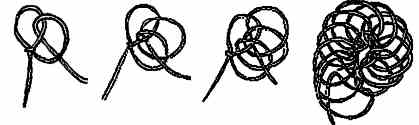
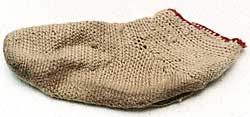
 

(Photos: l-r: spiral nal-binding_sketch; Sock found in York; from Hurstwic.org.)

~~~

How does this personally relate to me in regards to Loki?

Loki has been referring me to knots and knotwork for many years now, and as it is with His method, I hadn’t any idea as to why He was always referring to such things, either literally or metaphorically.  But I’m starting to connect some things about knots and knotwork today.

But, barring that, it does give His references to ‘creating sockpuppets’ a whole new meaning, eh?
 

Ragnarok

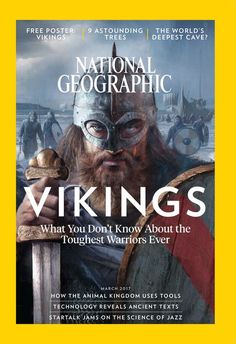
Even though I am over a month late in posting my thoughts, I could not wait to read National Geographic’s most recent article on the Vikings, which appeared in their March 2017 issue.

While much of the article concerned recent discoveries made about Viking culture of which I was already familiar, an intriguing theory concerning Ragnarok was mentioned on pages 38-9:

 In the nearly three centuries before the raids on foreign shores began around AD 750, Scandinavia was wracked by turmoil, [Neil] Price [of Uppsala University, Sweden] says. More than three dozen petty kingdoms arose during this period, throwing up chains of hill forts and vying for power and territory.  In the midst of these troubled times, catastrophe struck.  A vast cloud of dust, likely blasted into the atmosphere by a combination of cataclysms – comets or meteorites smashing into the Earth, as well as the eruption of least one large volcano–darkened the sun beginning in AD 536, lowering summer temperatures in the Northern Hemisphere for the next 14 years. The extended cold and darkness brought death and ruin to Scandinavia, lying as it did along the northern edge of medieval agriculture. In Sweden’s Uppland region, for example, nearly 75 percent of villages were abandoned, as residents succumbed to starvation and fighting.  

So dire was this disaster that it seems to have given birth to one of the darkest of all world myths –the Nordic legend of Ragnarok, the end of creation and the final battle, in which all gods, all supernatural beings, and all human beings and other living creatures die.  Ragnarok was said to begin with Fimbulwinter, a deadly time when the sun turns black and the weather turns bitter and treacherous–events that eerily parallel the dust veil that began in 536, Price says.*

        I had never considered that there could have been an actual historical event upon which Ragnarok was based.

        Fascinating.

~~~~

  • Vikings: What You Don’t Know About the Toughest Warriors Ever, by Heather Pringle, National Geographic, March 2017, pp 38-9)