~~ANIMALS ASSOCIATED WITH LOKI~~
Common/Lore attributed
Horse:
In the form of a mare, Loki gave birth to Sleipnir, as attested in the Hyndluljóð, a portion of theVöluspá in the Poetic Edda. This story is also mentioned in the Gylfaginning of the Prose Edda
Salmon:
After leaving Aegir’s hall in the Lokasenna, in the Poetic Edda, Loki takes the form of a salmon to escape capture from the Gods who seek to punish Him
Biting fly/flea
In the Skáldskaparmál, as Loki has cut off the hair of Sif, and under threat of injury from an angry Thor, He visits two dwarves of Svartelheim who create three gifts – a wig of golden hair for Sif, the spear Gungnir, and the ship Skíðblaðnir. Loki then goes to another pair of dwarves and bets them His head that they can’t make three things as fine as the three treasures created by that first pair. While the dwarves are working, Loki takes the form of a biting fly in order to sabotage their work – which produces Thor’s hammer Mjölnir, the golden boar Gullinbursti, and the ring-giver Draupnir.
As well, Loki takes the form of a biting flea as told in the skaldic poem Húsdrápa, in the Prose Edda. Loki takes on this form to gain access to Freyja’s bed-chamber so that He may steal Freyja’s necklace, the Brísingamen. As well this same story is referenced in the Sörla þáttr, a short story from the Flateyjarbók, a 14th-century Icelandic manuscript.
Seal/Otter
As described in the Húsdrápa, when Freyja awakens to find Her necklace, the Brísingamen, missing, she asks Heimdallr to help her search for it. Eventually, they realize that Loki has taken it and has transformed himself into a seal. Heimdallr turns into a seal as well and fights Loki. After a lengthy battle, Heimdallr wins and returns Brísingamen to Freyja.
Falcon:
In the Þrymskviða (Lay of Thrym) of the Poetic Edda, a Jotun king, Thrym steals Thor’s hammer, Mjölnir. Freyja lends Loki Her falcon cloak to search for it.
As well, Loki borrows Freyja’s magic falcon cloak again, to rescue Idunn from Jötun Þjazi, in the Skáldskaparmál.
Vultures:
One of Loki’s kennings is Gammleið. This Old Norse phrase is commonly translated as “vulture’s path” associating Loki with Lopt (‘Air’) in the ÞÓRSDRÁPA, Stanza 2, verses 1-4, of the Codex Regius
Common Folklore/UPG attributed
Spiders:
The only academic source I have come across connecting Loki with spiders refers to a treatise written by Swedish folklorist Anna Birgitta Rooth in 1961, titled Loki in Scandinavian Mythology. Her treatise attempts to connect Loki within the context of Scandinavian folklore as a trickster figure, much like Anansi the Spider in African and African American folklore. Since the basis of her connections of Loki with spiders seems to rest mostly upon her speculations regarding the etymology of the word locke (a Swedish dialect word for“spider”), Rooth’s book on Loki has been met with more criticism than acceptance from other scholars. While Rooth’s conclusions are often referenced, I know of very few scholars who would agree with her conclusions.
Though from the standpoint of personal gnosis, I’ve found many Lokeans do associate Loki with spiders anyway, casting Loki in a metaphorical spider role – as a weaver of wyrd, a tier of knots, and maker of nets.
(On a related note, I recall that it been theorized somewhere that Sleipnir’s eight legs could be either a reference to spiders or symbolic of four pall-bearers at a funeral – but I cannot recall the source on that connection.)
Common UPG by Association
Snakes:
This is a complex one. Many may associate Loki with snakes, due to His association with one of His offspring with the giantess Angrboða, Jörmungandr. But snakes as a symbol of Loki could also be due to the association of snakes as symbols of intuitive wisdom, transformation, fertility and balance of energy as seen across several cultures. In Native American lore, snakes represent several forms of duality – the duality of gender (male and female), lunar and solar, and as well as creatures associated with the elements of fire and water. As a shapeshifting form in Celtic mythologies, snakes are regarded as creatures capable of cunning transformation, as they shed their skins. As well, it was believed by the Celts that snakes lived and moved within the shadow realms (underground) for half the year, and therefore, when emerging with the sun, snakes were considered creatures who possessed hidden knowledge of the Earth and its rhythms. As symbols in Hinduism, snakes are considered wise healers, possessing a balance of energies – dark and light.
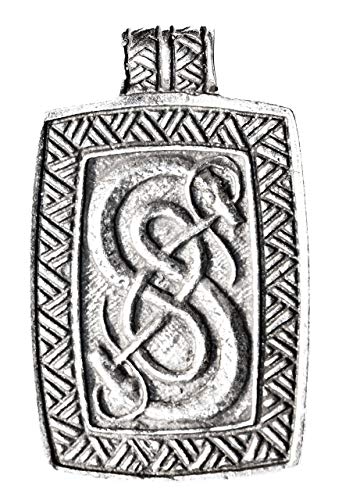
In that regard of the larger picture of snakes as symbols, I can definitely see how Loki could be associated with snakes. Therefore, it is perhaps no wonder that the Urnes snakes seem to have become one of the most popular symbols that many Lokeans have come to associate with Loki in the past ten years.
Wolves
As it is with Jormungandr, Loki as a wolf may simply be another association with another of His offspring with Angrboða, Fenrir. Many Lokeans claim UPG where Loki comes across as very much like a wolf – whether in actual guise or in manner/personality – whenever Loki is being sociable, loyal, protective or even aggressive at times.
Personally, I can see the correlation to wolves in terms of Loki’s seemingly insatiable appetites, but also in His attitudes towards whom He regards as His – whether they be family, friend or foe.
Common/UPG
Foxes, Hares, Raccoons, Crows, and Ferrets
These associations are likely due to Loki’s role as a Trickster Deity, as these creatures are all forms associated with Tricksters throughout many cultures.
And in an interesting bit of Icelandic folk belief that I came across recently connects quite well with my previous entry:
From a mutual FB group member, Hrafnsunna Ross – a self-described person of Croation and Scottish descent who was raised in Iceland – has this to say about Loki’s appearance and His association with foxes:
“In Iceland, Loki is depicted with light to dark brown hair. It makes sense for Loki to have brownish-grey hair because He is associated with Bragðarefur (‘Trick Fox’)…. as most foxes in Iceland are either dark grey/brown all year….(or a) lightish colored that turns white by winter.”
Lesser known Associations:
Axolotls
I’ve known a few Lokeans who associate the axolotl lizard with Loki presumably due to the fact that these amphibians exist at maturity in an in-between stage of metamorphosis called neoteny – a state of liminality.
Axolotls retain their larval gills into adulthood and this retention allows axolotls to remain aquatic for the duration of their lives.
Another name for axolotl is Mexican salamander.
 bloodteethandflame