bloodteethandflame

A life in threes

Tag: connections

Month for Loki: Six

Do you believe that Loki and Lóðurr from the creation myth are the same god? Why or why not?

Yes, I do believe that Loki, Loptr, and Lóðurr could be references to the same — if not different faces/aspects of the same deity.

(a) There’s the theory proposed by the scholar Ursula Dronke that Lóðurr is “a third name of Loki/Loptr”. Her argument rests upon the mention of Odin, Hœnir, and Loki as a trio of Norse deities/beings in a few late folkloric writings, including the Haustlöng, in the prologue to Reginsmál, and also in the Faroese ballad, Loka Táttur.

(b) As well, the kenning for Odin, Lóðurr’s friend appears to parallel another well-known kenning for Odin, Loptr’s friend – just as Loki is similarly referred to as Hœnir’s friend in the Haustlöng — which I believe further suggests their connection as a trio of deities/beings.

While many scholars may agree with this identification, I realize that it is not universally accepted. One argument that can be made against this argument is that Loki appears as a malevolent being later in Völuspá, which does seem to conflict with the image of Lóðurr as a “mighty and loving” figure.

Many scholars, including Jan de Vries and Georges Dumézil, have also identified Lóðurr as being the same deity as Loki.

(c) Scholar Haukur Þorgeirsson suggests that Loki and Lóðurr were different names for the same deity based on that Loki is referred to as Lóðurr in the rímur Lokrur.(1) Þorgeirsson argues that the writer of the rímur Lokrur may have had access to information about this identification from an earlier traditional extant tale or that perhaps the author had drawn that conclusion based on a possible comparative reference to the Prose Edda, as Snorri does not mention Lóðurr.

Since knowledge of the contents of the Poetic Edda could just as easily not have been accessible – or familiar – to every poet around 1400 AD when the rímur was written, still Þorgeirsson argues for the traditional identification, by pointing to Þrymlur where the same identification is made with Loki and Lóðurr. Again, Þorgeirsson mentions the possibility that the 14th- and 15th-century poets possessed written sources unknown to us, or the idea must have come from an unlikely source where the poets could have drawn a similar conclusion that Loki and Lóðurr are identical, but the sources of that (possibly oral) tradition remain presently unknown. He concludes that if Lóðurr was historically considered an independent deity from Loki, then a discussion of when and why Lóðurr became identified with Loki is an intriguing concept that deserves more exploration, and in his article (linked below), he discusses what he believes are several possibilities, based upon what is known about poetic and linguistic structures in the 14th and 15th century.

(d) Since the Prose Edda mentions the sons of Borr in the same context as Völuspá mentions Hœnir and Lóðurr, some scholars have reasoned that Lóðurr might be another name for either Vili or Vé. (Viktor Rydberg was an early proponent of this theory, even though it seems that he may have abandoned support of it later, as mentioned by Þorgeirsson in his article linked below .)

~~

(1) “Outside of the rímur, the name Lóðurr occurs in three Old Icelandic poems; Háleygjatal, Íslendingadrápa, and Völuspá. In each case, it indicates a figure associated with Óðinn, but scholars have been divided on exactly whom the name refers to. The theory which is most frequently defended – and most frequently attacked – is that the name refers to Loki.” from Haukur Þorgeirsson’s article, “Lokrur, Lóðurr, and Late Evidencehere (on Academia.com)


Month for Loki: One

Welcome to July!

As some of you may or may not know, July is the month that many Lokeans dedicate specifically to Loki.  

For this reason, every July, I like to spend a bit of time each day either writing, meditating, or engaging in some form of devotional activity, and then dedicating those efforts to Loki.

This year, I will be using some writing prompts developed by fellow Lokean, Dagny created for each day in July.

For the 1st of July: I first discovered Loki when…

As I may have written before, I don’t know exactly when I first ‘discovered’ Loki for myself. What I do know is that my love of reading fairy tales, folk tales, and world mythology probably led me to read about Him at some point.

Perhaps it began when I read about Loki in D’Aulaire’s Norse Gods and Giants:

Or maybe my knowledge of His existence began even earlier than that when I discovered Him within the various stories found within The Children’s Library Collection, a 12-volume set of books that my father had read throughout his childhood in the 1940s.

I remember sitting in my grandfather’s leather easy chair, with this or that volume propped up on my lap, trying to work my way through a European folktale, and feeling delighted with the lively orange and black line illustrations of a clever fox who can run as fast as the wind if only one can hold unto his bushy tail with both hands, or that big helpful bear who carries a young girl on his back so that she may travel safely through a dark forest to reach the witch at the edge of the valley :

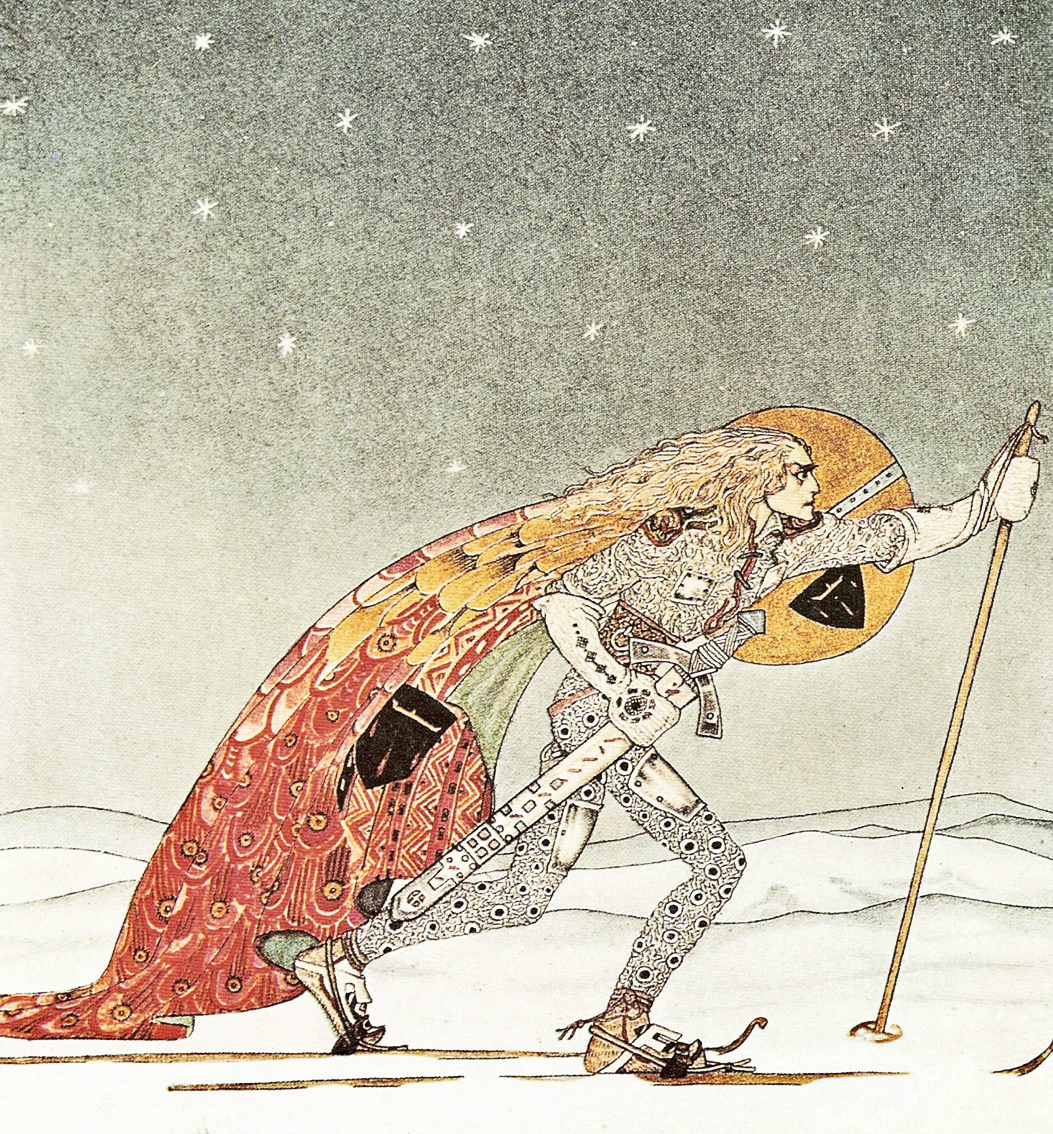
Loki, illustration by Kay Nielsen

Either way, Loki became familiar to me as a short word that I was confident that I could read (and pronounce!) because it only had four letters — and I remember my Dad mentioning that the capital letter meant that it was a name.

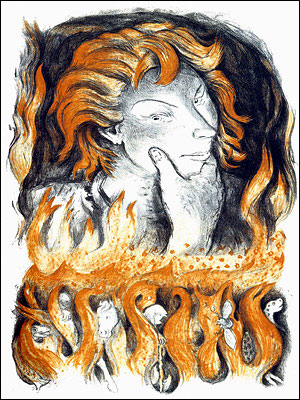
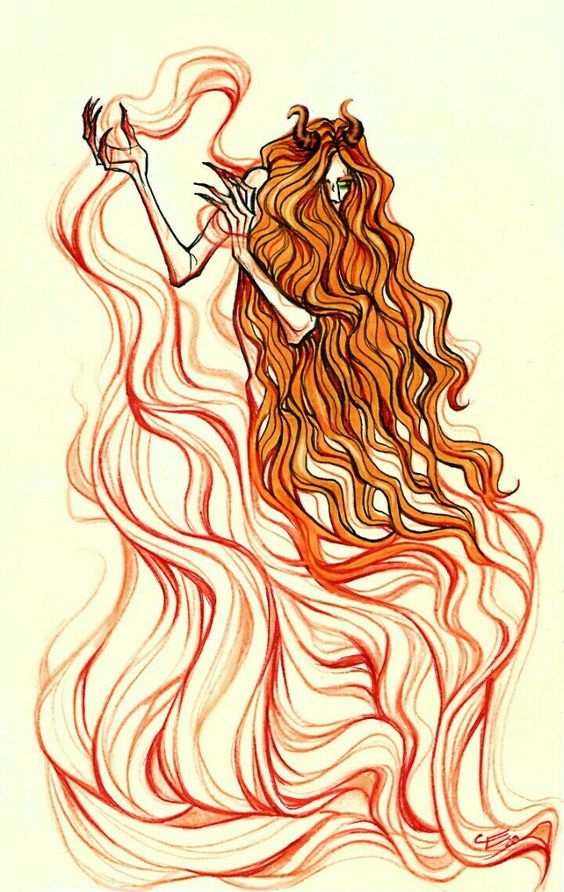
MfL Six: Burning inside

Describe your God as something that occurs in nature.

*** UPG alert ***

Hail Loki!

#30 days

Month for Loki: Ten

Dver wrote a great post about a way to look at relationships with the Gods which gave me lots of food for thought.


You see, I’ve been going through a bit of a weird emotional patch.

I’ve been feeling disconnected from everything.

When I read of how Dver writes of her relationships with Gods in regards to her devotional practice, what I found interesting is that she generally splits them into two groups: Gods whom she loves and she works with closely/offers to regularly — and Gods whom she loves simply for Their existence.

She writes:

“There are some gods I love – have loved for decades, even – and have never had a single, personal, direct experience with. I don’t know if I’m on Their radar at all. I don’t need to be. It’s enough to know Them even a little bit, and to honor Them. I don’t ask Them for anything, typically. Maybe I just keep an image of Them somewhere, make an offering now and then, read Their stories, and appreciate Their existence. That’s all it needs to be.”


Interestingly, this concept intertwines with a discussion of ego – and how removing oneself from the equation of love was liberating, as love given with the desire for reciprocation was simply ego…and how to love simply for the basis of loving because of the other’s existence was the most profound sort of love, and therefore the sort of love to be sought when speaking of the Gods, i.e the Gods should be loved without the (ego’s) expectation of reciprocation or interaction.


But by the same token, Dver admits to believing that the Gods that she serves daily in her practice do love her in Their way (as love is at its core and is understood to be an energetic act directed towards another/what is outside of the self) but that to serve in exchange for being loved is neither her goal nor her intent.

And I found that profoundly helpful as I navigate my feelings about Loki and Odin today: up until that moment of understanding, I would have said that what is going on with me is that They both feel like old friends that I haven’t seen or interacted with in a while.

Or as the Hávamál would say, I have allowed weeds and high grass to grow over the path to my friends’ home:


…if you have a friend,

and you trust him,

go and visit him often.

Weeds and high grass

will grow on a path

that nobody travels.

Stanza 119, trans. by Jackson Crawford

So, in that regard, I’ve been feeling guilty and sad.

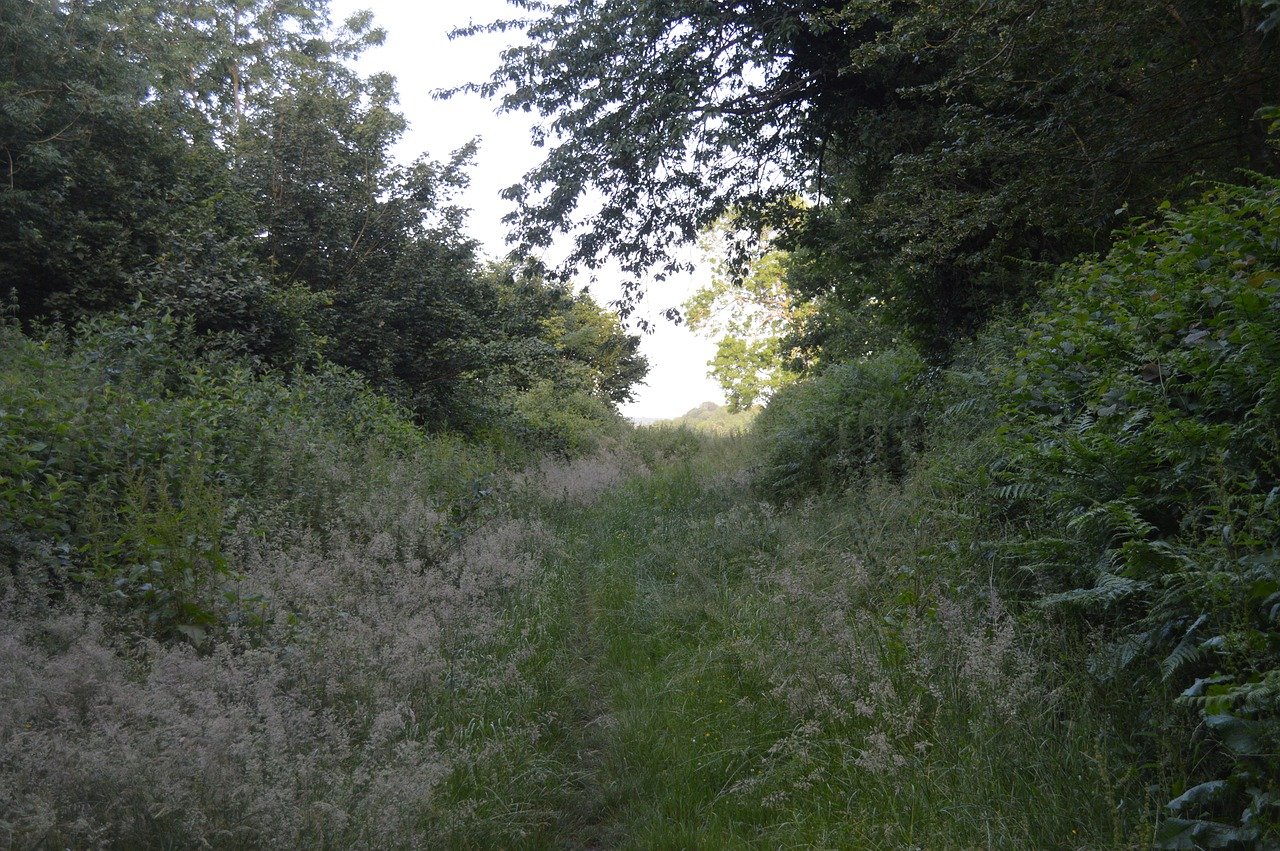
An overgrown path


So I asked myself, what would it feel like to love them without any expectation of Their presence or interaction?


Which leads me to this other personal bit: a new Lokean in one of my groups is asking how one can become so close to Loki that He would ‘show up’ without being called on/summoned?
Several folks responded that Loki shows up for them only when He isn’t being sought out, and that it was a well-known secret that Gods do show up if you think of Them enough, and Loki especially; Loki will eventually show up… the keyword being eventually.


As for me, I am going to work on loving Them simply for being/existing and see how that goes.


I’m not adverse to simply being the devotee for a while. And I think about


Love.
Just love.
Let it flow out of you unimpeded.
And I will be there.
And you will know.

~~

Month for Loki: Nine

Nine in Norse Mythology, from Wikipedia:

  • Nine worlds that are supported by Yggdrasil.
  • At the end of Skáldskaparmál is a list of nine heavenly realms provided by Snorri, including, from the nethermost to the highest, Vindblain (also Heidthornir or Hregg-Mimir), AndlangVidblain, Vidfedmir, Hrjod, Hlyrnir, Gimir, Vet-Mimir and Skatyrnir which “stands higher than the clouds, beyond all worlds.”
  • Every ninth year, people from all over Sweden assembled at the Temple at Uppsala. There was feasting for nine days and sacrifices of both men and male animals according to Adam of Bremen.
  • In Skírnismál, Freyr is obliged to wait nine nights to consummate his union with Gerd.
  • In Svipdagsmál, the witch Gróa grants nine charms to her son Svipdag. In the same poem there are nine maidens who sit at the knees of Menglod.
  • In Fjölsvinnsmál, Laegjarn’s chest is fastened with nine locks.
  • During Ragnarök, Thor kills Jörmungandr but staggers back nine steps before falling dead himself, poisoned by the venom that the Serpent spewed over him and after that, he resurrected himself.
  • According to the very late Trollkyrka poem, the fire for the blót was lit with nine kinds of wood.
  • Odin’s ring Draupnir releases eight golden drops every ninth night, forming rings of equal worth for a total of nine rings.
  • In the guise of Grímnir in the poem Grímnismál, Odin allows himself to be held by King Geirröd for eight days and nights and kills him on the ninth after revealing his true identity.
  • There are nine daughters of Ægir.
  • There are nine mothers of Heimdall.
  • There are nine great lindworms: Jörmungandr, Níðhöggr, Grábakr, Grafvölluðr, Ofnir, Svafnir, Grafvitni and his sons Góinn and Móinn.
  • The god Hermod rode Sleipnir for nine nights on his quest to free Baldr from the underworld.
  • The giant Baugi had nine thralls who killed each other in their desire to possess Odin’s magical sharpening stone.
  • The god Njord and his wife Skadi decided to settle their argument over where to live by agreeing to spend nine nights in Thrymheim and nine nights at Nóatún.
  • The giant Thrivaldi has nine heads.
  • The clay giant Mokkurkalfi measured nine leagues high and three broad beneath the arms.
  • When Odin sacrificed himself to himself, he hung upon the gallows of Yggdrasill for nine days and nights. In return, he secured rúnar ‘runes, secret knowledge’.
  • The valknut symbol is three interlocking triangles forming nine points.
  • There are nine surviving deities of Ragnarök, including Baldr and Hödr, Magni and Modi, Vidar and Váli, Hoenir, the daughter of Sól and a ninth “powerful, mighty one, he who rules over everything”.

Month for Loki: Eight

Loki is big on the concept of “negative capability,” which John Keats defines as, “when a man is capable of being in uncertainties, mysteries, doubts, without any irritable reaching after fact and reason.” Namely, that a poet must remain open to all ideas, to all identities–even to the point of obliterating one stable identity–if that poet is to remain truly creative. Basically: embrace uncertainty, because it leads to change, and change is generative and inherently creative.

Month for Loki: Five.

“Lokkr is the art of calling something towards oneself.

Lokkr is the art of compelling, the art of affecting change from the inside.

Lokkr is the art of singing the sweetest songs, using the most alluring words.

The most irresistible commands come from the breath, yet they seem as fragile as leaves in the wind

Lokkr is how we draw energy, how we pull magic towards us.”

                                                                                                 -Valas, Haegen

Artwork by Muirin007

A companionable silence

Things are changing and while I am not sure I wanted them to change, they did.

It’s been a while.

One of the things that seem changed is that They haven’t felt as ‘present’ lately…or at least, my sense of Them has been feeling a lot more abstract, perhaps removed.

Y’see, as much as I hate to admit this, I have been beating myself up a little lately, allowing myself to feel anxious, thinking that Their subdued presence was due entirely to my lack of interaction…and while that feels true on one level, it feels equally untrue on another level.

Meanwhile, a post by Jolene Dawe came across my feed recently that definitely featured a message that I needed to hear/read about relationships, change and acceptance.

In any case, Jolene’s words gave me some means to frame what’s been going on (or in some cases, what’s not going on) in my own practice.

Her insight into her feelings/thoughts about her journey helped me process the feelings and thoughts I’ve been having about my own.

Upon reading, it occurred to me that perhaps she was going through something similar to what I’ve been going through in my own practice – and that powder-keg moment surrounded her assertion that she felt like a hypocrite for creating a liturgy.

What is a liturgy? I found myself thinking, as my brain leapt to wondering…

Was she talking about a writing project?

If her liturgy writing project was going in any way similar to the way my latest writing project is going for me, I wondered if she too was debating with herself over the reason that things seemed to be…fizzling out.

Perhaps she too was trying to decipher if the project was dying a natural death or if she was somehow, inadvertently mucking it up.

At any rate, I could definitely relate to that inner debate, mulling over the concepts of hypocrisy, inaction, the evolution of relationships with what’s imminent vs what isn’t…

I especially found myself identifying with her discussion of the desire to be close vs. not feeling so close to Them (i.e the state of feeling connected to the Gods vs. feeling ‘Godless’.)

I liked her metaphor/line of thinking about God-relationships: that if P was an actual person, she could call Him up and They could chat about old times in a way that honors the meaning of what their relationship used to be

…without getting caught up in nostalgia or pining over what used to be because she wants it back.

(Or letting herself get mired in that feeling like she should want things to go back to the way things were.)

I’ll be honest, I was heartened to read when she admitted to feeling (mostly) at peace with the fact that she couldn’t go back

and doesn’t want to anyway.

And that got me to thinking how I began my life as a Pagan: I will admit that I spent a long time feeling like a Godless Pagan, as I do recall that some of my initial attempts at a devotional practice were spurred on by anxiety:

feeling

that I wanted to be closer to Them to the nth degree

that I needed to be connected to Them to the nth degree

And that acute feeling like The Goal of It All had always been to connect to Them to this nth degree.

But then to experience the level of connection that I’d so long sought?

(Oh there is sheer blissful NRE in having THAT connection…)

But did I ever expect that that intense level of connection could (inevitably!) change?

Honestly, I did not.

Now this is where it got kinda messy in my head because, yes, though I know what I’d always been told…

The only thing constant in this world is change:

*

Well, of course, relationships change.

But I will admit I wasn’t really prepared to fathom any level of change in my relationship with Them.

So now to experience these moments of what my anxiety wants to define as ‘less’ and ‘lack’ feels like a terrible loss.

But is it?

Perhaps I need to learn to reframe my perspective.

So perhaps I don’t have the same intense connection with Them that I used to have.

(and yes, I am aware of how part of it is my fault if one wants to assign blame)

but perhaps, the other part of it is

just a rather natural evolution towards something

more settled

not as imminent

not as active

as I had previously expected.

But is there any need to for me to feel so anxious about it?

Perhaps not.

Perhaps I should welcome the change as a sign of growth in my relationship with Them.

Perhaps I should welcome this companionable silence

~~~

*Well, Loki IS a God of Change, now isn’t He?

Month for Loki, Day 20: Animal Associations

~~ANIMALS ASSOCIATED WITH LOKI~~

Common/Lore attributed

Horse:

In the form of a mare, Loki gave birth to Sleipnir, as attested in the Hyndluljóð, a portion of theVöluspá in the Poetic Edda. This story is also mentioned in the Gylfaginning of the Prose Edda

Salmon:

After leaving Aegir’s hall in the Lokasenna, in the Poetic Edda, Loki takes the form of a salmon to escape capture from the Gods who seek to punish Him

Biting fly/flea

In the Skáldskaparmál, as Loki has cut off the hair of Sif, and under threat of injury from an angry Thor, He visits two dwarves of Svartelheim who create three gifts – a wig of golden hair for Sif, the spear Gungnir, and the ship Skíðblaðnir. Loki then goes to another pair of dwarves and bets them His head that they can’t make three things as fine as the three treasures created by that first pair. While the dwarves are working, Loki takes the form of a biting fly in order to sabotage their work – which produces Thor’s hammer Mjölnir, the golden boar Gullinbursti, and the ring-giver Draupnir.

As well, Loki takes the form of a biting flea as told in the skaldic poem Húsdrápa, in the Prose Edda. Loki takes on this form to gain access to Freyja’s bed-chamber so that He may steal Freyja’s necklace, the Brísingamen. As well this same story is referenced in the Sörla þáttr, a short story from the Flateyjarbók, a 14th-century Icelandic manuscript.

Seal/Otter

As described in the Húsdrápa, when Freyja awakens to find Her necklace, the Brísingamen, missing, she asks Heimdallr to help her search for it. Eventually, they realize that Loki has taken it and has transformed himself into a seal. Heimdallr turns into a seal as well and fights Loki. After a lengthy battle, Heimdallr wins and returns Brísingamen to Freyja.

Falcon:

In the Þrymskviða (Lay of Thrym) of the Poetic Edda, a Jotun king, Thrym steals Thor’s hammer, Mjölnir. Freyja lends Loki Her falcon cloak to search for it.

As well, Loki borrows Freyja’s magic falcon cloak again, to rescue Idunn from Jötun Þjazi, in the Skáldskaparmál.

Vultures:

One of Loki’s kennings is Gammleið. This Old Norse phrase is commonly translated as “vulture’s path” associating Loki with Lopt (‘Air’) in the ÞÓRSDRÁPA, Stanza 2, verses 1-4, of the Codex Regius

Common Folklore/UPG attributed

Spiders:

The only academic source I have come across connecting Loki with spiders refers to a treatise written by Swedish folklorist Anna Birgitta Rooth in 1961, titled Loki in Scandinavian Mythology. Her treatise attempts to connect Loki within the context of Scandinavian folklore as a trickster figure, much like Anansi the Spider in African and African American folklore. Since the basis of her connections of Loki with spiders seems to rest mostly upon her speculations regarding the etymology of the word locke (a Swedish dialect word for“spider”), Rooth’s book on Loki has been met with more criticism than acceptance from other scholars. While Rooth’s conclusions are often referenced, I know of very few scholars who would agree with her conclusions.

Though from the standpoint of personal gnosis, I’ve found many Lokeans do associate Loki with spiders anyway, casting Loki in a metaphorical spider role – as a weaver of wyrd, a tier of knots, and maker of nets.

(On a related note, I recall that it been theorized somewhere that Sleipnir’s eight legs could be either a reference to spiders or symbolic of four pall-bearers at a funeral – but I cannot recall the source on that connection.)

Common UPG by Association

Snakes:

This is a complex one. Many may associate Loki with snakes, due to His association with one of His offspring with the giantess Angrboða, Jörmungandr. But snakes as a symbol of Loki could also be due to the association of snakes as symbols of intuitive wisdom, transformation, fertility and balance of energy as seen across several cultures. In Native American lore, snakes represent several forms of duality – the duality of gender (male and female), lunar and solar, and as well as creatures associated with the elements of fire and water. As a shapeshifting form in Celtic mythologies, snakes are regarded as creatures capable of cunning transformation, as they shed their skins. As well, it was believed by the Celts that snakes lived and moved within the shadow realms (underground) for half the year, and therefore, when emerging with the sun, snakes were considered creatures who possessed hidden knowledge of the Earth and its rhythms. As symbols in Hinduism, snakes are considered wise healers, possessing a balance of energies – dark and light.

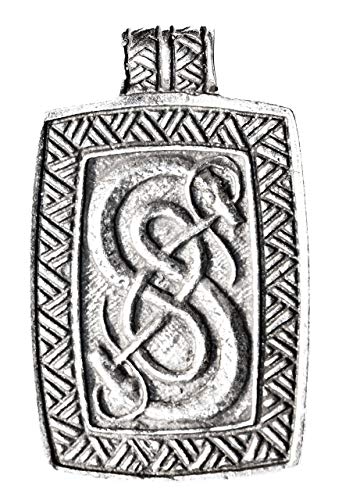
In that regard of the larger picture of snakes as symbols, I can definitely see how Loki could be associated with snakes. Therefore, it is perhaps no wonder that the Urnes snakes seem to have become one of the most popular symbols that many Lokeans have come to associate with Loki in the past ten years.

Wolves

As it is with Jormungandr, Loki as a wolf may simply be another association with another of His offspring with Angrboða, Fenrir. Many Lokeans claim UPG where Loki comes across as very much like a wolf – whether in actual guise or in manner/personality – whenever Loki is being sociable, loyal, protective or even aggressive at times.

Personally, I can see the correlation to wolves in terms of Loki’s seemingly insatiable appetites, but also in His attitudes towards whom He regards as His – whether they be family, friend or foe.

Common/UPG

Foxes, Hares, Raccoons, Crows, and Ferrets

These associations are likely due to Loki’s role as a Trickster Deity, as these creatures are all forms associated with Tricksters throughout many cultures.

And in an interesting bit of Icelandic folk belief that I came across recently connects quite well with my previous entry:

From a mutual FB group member, Hrafnsunna Ross – a self-described person of Croation and Scottish descent who was raised in Iceland – has this to say about Loki’s appearance and His association with foxes:

“In Iceland, Loki is depicted with light to dark brown hair. It makes sense for Loki to have brownish-grey hair because He is associated with Bragðarefur (‘Trick Fox’)…. as most foxes in Iceland are either dark grey/brown all year….(or a) lightish colored that turns white by winter.”

Lesser known Associations:

Axolotls

I’ve known a few Lokeans who associate the axolotl lizard with Loki presumably due to the fact that these amphibians exist at maturity in an in-between stage of metamorphosis called neoteny – a state of liminality.

Axolotls retain their larval gills into adulthood and this retention allows axolotls to remain aquatic for the duration of their lives.

Another name for axolotl is Mexican salamander.

Month for Loki, Fourteenth: Knot.

In the summer of 2012, I had one of the first of a series of strange vivid dreams  that involved Loki:

In this particular dream, I found myself searching through  a building of many rooms, and while I didn’t know what or who I was looking for, I knew I was looking for something…or someone.

Most of the rooms were spacious but empty – white walls, sparsely furnished, lit by buzzing fluorescent ceiling panels.  Like an abandoned office building, which I sensed may or may not be underground.

And then I was surprised to come upon what appeared to be a middle-aged man with dark auburn hair in one of the rooms.  As I’d mentioned, though most of the rooms were nothing more that white empty walls, the room this man was in was full of  brightly colored yarn.   Skeins of various colors and in various states of unravel lay scattered all over the floor.  While a few seemed no more than tangled handfuls of yarn, others were neatly wound and stacked in piles of three or four bundles, sorted by color.

Meanwhile the biggest jumble of knots lay closest to the man’s right foot.  I could also see that he was barefoot…. and he wasn’t exactly sitting in the chair.

This man was sprawled in an elaborately carved wooden chair large enough to easily be mistaken for some sort of throne.  I say sprawled because though I came upon him sitting upon this odd throne from behind and at somewhat of an angle, I immediately realized that this man was quite gangly; one of his legs casually dangled over one of the arm rests, and I couldn’t help but wonder how he’d  miraculously found a way to fold the length of the rest of his body comfortably within the confines of the seat.  

I don’t think he noticed me at first, as his head was bent in concentration upon his hands and the tangled mess of colored yarn in his lap.

However, when he did finally look up at me

He grinned….and casually asked me

if I knew

who he was.

Loki.

And Loki appeared to be knitting.  

But not with needles, mind you; He seemed to be knitting with His fingers.

(from my notebook, 17 July 2012)

~~~

But I learned something interesting today.

It occurs to me that Loki may not have been knitting.

He may have been nålbinding (“needle-binding”), an ancient technique which may pre-date knitting and crocheting by 1500 years, where a single length of thread or yarn is passed through loops by use of a single needle, and the resulting fabric is sturdily connected by interlocking these loops of yarn or thread with one another.  Nålebinding is also called ‘knotless netting.’

I came across this information today – though honestly I was researching something else that had nothing at all to do with Norse clothing -but a reference to socks caught my eye and I found my way to Hurstwic.org:

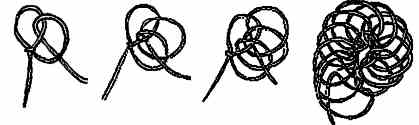
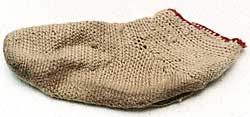
“However, Norse socks were not knitted (which apparently was unknown to the Norse). Instead, they were made using an ancient technique called nálbinding (needle-binding). Using a single large, thick needle, it was a method of knotting the yarn. Although time consuming, this approach resulted in a nearly indestructible garment. If the thread were to break or wear out, the garment would still be intact, since the thread was everywhere knotted to neighboring threads. Mittens and caps were also made using this technique. The sketch to the left shows the steps involved in making an article of clothing using the nálbinding technique. Note that the fabric grows in a spiral pattern. Once the spiral is large enough, it is knotted back on itself to create the shape of the finished article.”


(Photos: l-r: spiral nal-binding_sketch; Sock found in York; from Hurstwic.org.)

~~~

How does this personally relate to me in regards to Loki?

Loki has been referring me to knots and knotwork for many years now, and as it is with His method, I hadn’t any idea as to why He was always referring to such things, either literally or metaphorically.  But I’m starting to connect some things about knots and knotwork today.

But, barring that, it does give His references to ‘creating sockpuppets’ a whole new meaning, eh?